Bitcoin Market Recap: Fed’s Warsh Pulls the Rug on a $81K High
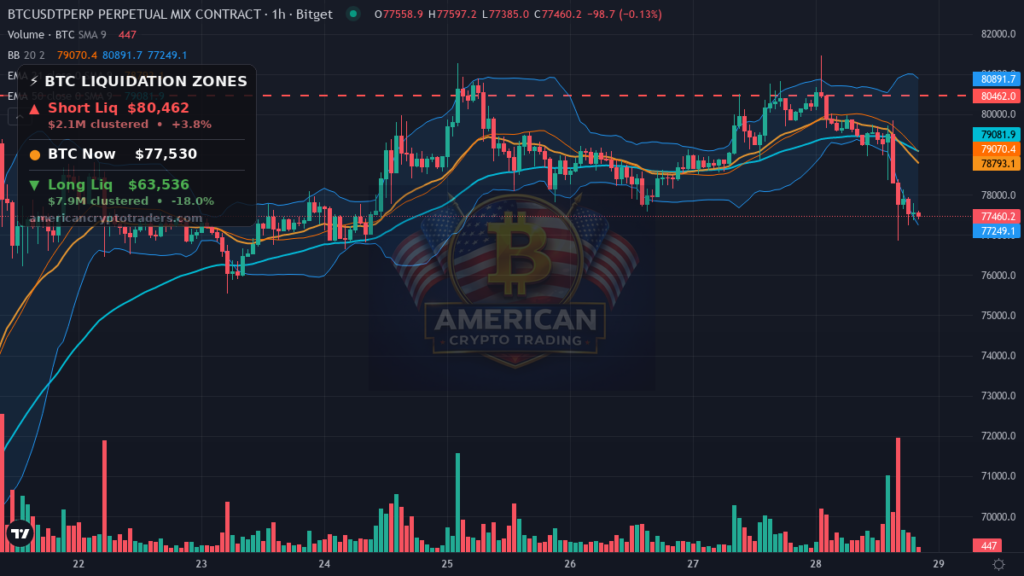
Friday’s New York session delivered a sharp reminder that macro still runs the show. Bitcoin opened the day pressing toward $81,465 before Federal Reserve Governor Kevin Warsh stepped in front of a microphone and dismantled the rate-cut narrative, sending BTC tumbling to a session low of $76,846 before stabilizing near $77,491 — a loss of 3.08% on the day. This bitcoin market recap covers everything that moved, what the liquidation map looks like heading into the weekend, and the levels Asia traders will be watching overnight.
The damage was not limited to Bitcoin. Total crypto market cap fell 5.24% on the session to roughly $2.63 trillion, with altcoins absorbing a disproportionate share of the selling. BTC dominance held firm at 59.0%, a sign that traders rotated defensively into the largest asset rather than exiting the space entirely — cold comfort when everything is still red.
What Moved Markets Today
Fed Governor Warsh dismissed soft inflation prints, killing rate-cut hopes. Warsh’s comments arrived at a particularly sensitive moment: markets had been leaning on recent softer CPI and PCE data to price in an earlier easing cycle. His pushback was blunt — he signaled the Fed is not ready to declare victory on inflation — and the reaction was immediate. Rate-cut expectations repriced lower in real time, and risk assets from equities to crypto sold off in tandem as the “soft landing, early cuts” thesis took a body blow.
The DXY rose 0.51% to 99.67, and the U.S. 10-Year yield spiked 1.03% to 4.72%. These two moves together form the classic risk-off double-tap: a stronger dollar makes dollar-denominated assets less attractive to global buyers, while a rising 10-year yield raises the opportunity cost of holding speculative, non-yielding assets like Bitcoin and Ethereum. Gold was not spared either, dropping 2.2% to $4,508 — a telling sign that this was a broad liquidity and sentiment shock rather than crypto-specific selling. When gold and BTC fall together, the culprit is almost always a macro repricing event, not a structural crypto problem.
Solana’s disinflation vote passed in dramatic fashion — but the market didn’t care. Validators approved a proposal to accelerate the reduction in SOL token issuance, a structurally bullish change that reduces sell pressure from new supply over time. Under normal conditions, that kind of governance win would have driven a meaningful rally. Instead, SOL fell 5.02%, from a high of $110.58 all the way down to a low of $102.24, closing near $103.52. The lesson: even genuinely positive on-chain catalysts cannot outrun a hostile macro backdrop when yields are spiking and the dollar is strengthening. The fundamental improvement is real; the timing was just brutal.
Altcoin Action
Solana’s 5.02% drop made it the weakest of the majors, but the pain was widespread. Ethereum lost 2.79%, falling from a high of $2,534 to a low of $2,405, closing at $2,432. DOGE shed 4.18%, with its session range running from $0.0903 down to $0.0838, closing at $0.0847. Volume across all majors was elevated, consistent with liquidation-driven selling rather than orderly profit-taking.
On the broader leaderboard, the losers were ugly. VVV dropped 10.1%, LIT fell 8.9%, and BCH shed 8.1%. On the other side, BTW managed a 7.6% gain to lead all movers, with FIGR_HELOC up 3.5% and TRUMP adding 2.0%. Those three gainers look like isolated idiosyncratic bids in a sea of red — not a rotation, just noise against a broadly negative tape.
Positioning and the Liquidation Map
With BTC last trading near $77,530, the liquidation map offers a clear picture of the two-sided risk heading into the weekend. On the upside, a cluster of short liquidations sits at $80,462, representing approximately $2.12 million in leveraged short positions. A reclaim of that level would force those shorts to cover, adding mechanical buying pressure and potentially accelerating any relief rally back toward the $81,000 area where BTC was trading before Warsh spoke.
On the downside, the more consequential level is the long liquidation cluster at $63,536, which represents approximately $7.86 million in leveraged long positions — nearly four times the short-side exposure sitting above. A break below current support that extends to that level would trigger a cascade of forced selling, and thin weekend liquidity in the Asia session makes a momentum sweep more likely than it would be during peak U.S. hours. The asymmetry matters: there is meaningfully more fuel for a downside flush than for a short squeeze.
Funding rates for both BTC and ETH are sitting at a modest 0.0001 — essentially neutral. That tells us the market is not heavily leveraged long heading into this sell-off, which is actually a mild positive. A deeply positive funding environment would suggest crowded longs waiting to be liquidated; the current reading does not.
The Macro Picture
The S&P 500 closed down 0.25% at 7,711.76 — a relatively contained equity loss given the magnitude of the bond market move, suggesting institutional equity desks are not yet in full panic mode. But crypto historically front-runs risk sentiment shifts, and today’s session confirmed that pattern. The question for Asia traders is whether Warsh’s comments represent a one-day repricing or the beginning of a sustained hawkish pivot in Fed communication.
With the 10-year yield now at 4.72% and the DXY at 99.67, the technical levels in both traditional markets are worth watching overnight. If yields continue to creep higher and the dollar holds its bid, expect continued pressure on risk assets when Tokyo and London open. Conversely, any softening in either metric — perhaps from overnight Treasury market trading or dovish commentary from other Fed officials — could provide the relief valve crypto needs to stabilize.
Levels to Watch
On the downside, the immediate support zone is the session low at $76,846. A clean break and hold below that level on the Asia open opens the door to a test of the $75,000 psychological round number, and the liquidation cascade below $63,536 becomes a more pressing concern the longer BTC trades under $77K. On the upside, $79,000–$80,000 is the first meaningful resistance band, with the larger short-squeeze trigger waiting at $80,462. Reclaiming $80K with volume would shift the short-term tone back toward neutral.
Upcoming Catalysts
The macro calendar is relatively quiet heading into the weekend, with no scheduled Fed speakers or major U.S. data releases flagged for the immediate Asia and London sessions. That puts the overnight price action squarely in the hands of technical flows, overnight Treasury market moves, and any additional commentary that emerges from global central bank circles.
Sentiment Check
The Crypto Fear & Greed Index is sitting at 73 — Greed. That reading is notable given today’s 3% decline: retail sentiment has not yet capitulated, which means there is still room for positioning to get worse before the crowd turns fearful. Historically, greed readings during sell-offs suggest the crowd is still “buying the dip” mindset, which can extend downside when macro headwinds are structural rather than transient. For longer-horizon context on where August sits in the broader seasonal picture, see our 28-for-28 monthly candle analysis.
Bottom Line
Today’s session was a clean macro story: a Fed official spoke, yields jumped, the dollar strengthened, and risk assets sold off in an orderly but painful way. Bitcoin’s 3.08% loss from a $81K high to sub-$77,500 is significant, but the structure is not yet broken. Funding rates are neutral, dominance is holding, and the short-liquidation level at $80,462 gives bulls a clear target to reclaim. The real danger is a continuation move in U.S. 10-year yields overnight that pressures BTC through the $76,846 session low — that is the level to defend. Trade the levels, manage size for weekend liquidity conditions, and let the macro data do the talking.
Disclaimer: This recap is for educational and informational purposes only and does not constitute financial advice. Cryptocurrency trading involves substantial risk of loss. Always do your own research. American Crypto Traders and its contributors may hold positions in the assets discussed.