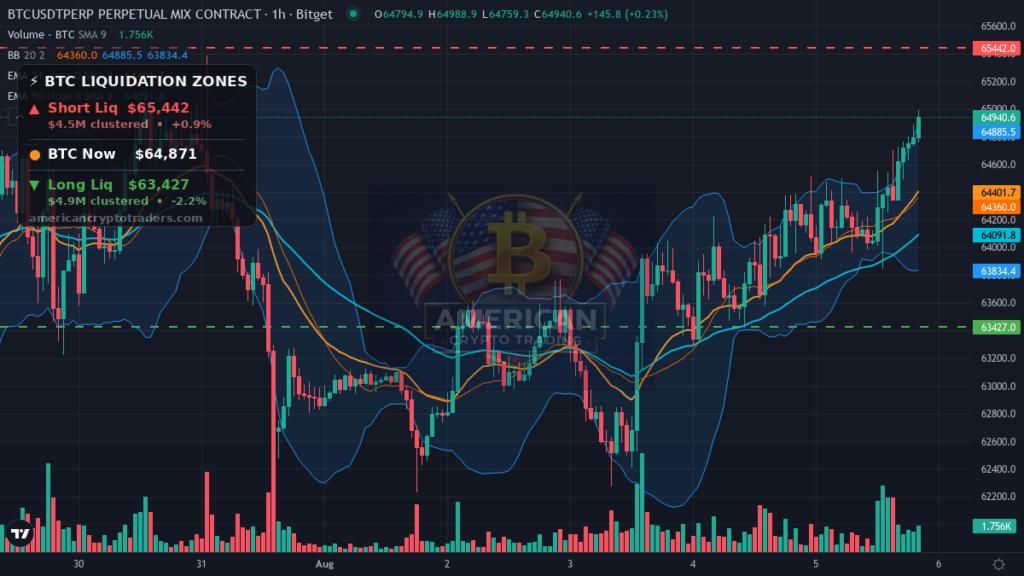
Wednesday’s New York session closed with Bitcoin at $64,940, up a measured 1.3% on the day but well short of matching the fireworks elsewhere in macro markets. This bitcoin market recap covers a session defined less by what crypto did and more by what it failed to do — gold screamed higher on heavy Chinese demand while BTC sat on its hands, a divergence that deserves serious attention heading into the Asian open. The broader crypto market cap ticked up 0.88% to $2.30 trillion, BTC dominance held at 56.7%, and sentiment remains mired in Fear territory.
Bitcoin Market Recap: A Reluctant Bid in a Muted Risk Environment
Bitcoin traded a $63,842 to $64,989 range through the session — roughly $1,147 from trough to peak — before settling just under $65,000. The bid that lifted prices off session lows lacked conviction; volume came in at approximately $2.42 billion on the 24-hour window, which is not the kind of participation that suggests aggressive accumulation. Price recovered but did not break out, and that matters for how you frame the overnight setup.
The S&P 500 slipped 0.17% to 7,723, the DXY edged down 0.17% to 99.72, and the 10-year yield dropped 0.22% to 4.62%. On paper, that is a mild risk-off, mild dollar-weakness backdrop that should have been a tailwind for crypto. Instead, BTC barely moved relative to gold’s 5.16% explosion. The macro context was not hostile — it was simply not compelling enough to attract fresh capital off the sidelines.
What Moved Markets Today
Gold surged 5.16% to $4,306.70 on heavy China demand, while Bitcoin failed to follow. Historically, a move of that magnitude in gold — driven by sovereign and institutional demand rather than panic — has tended to pull BTC higher with a short lag as macro-oriented funds rotate into “hard asset” narratives. That correlation did not show up today. The working theory is that risk-off sentiment and fearful retail positioning suppressed any reflexive bid in BTC, leaving the gold-BTC divergence as the single most important chart relationship to track into Thursday’s Asian session.
Western Union announced integration of stablecoin remittances via Visa and Stablecard rails, underscoring accelerating institutional adoption of dollar-pegged tokens. This is not a retail story — it is a plumbing story. When one of the world’s largest remittance corridors begins routing settlements through stablecoin infrastructure on Visa’s network, it signals that the compliance and counterparty-risk questions that once blocked enterprise adoption are quietly being resolved. Longer term, growing stablecoin transaction volume is constructive for overall on-chain activity and can translate into demand for native gas tokens and DeFi liquidity.
A crypto-backed Michigan House incumbent lost his primary election despite $2 million in PAC spending on his behalf. The result complicates the narrative that pro-crypto political spending translates cleanly into electoral outcomes or legislative leverage. That does not mean the crypto lobby is toothless — Senator Lummis is still pushing for a CLARITY Act vote before the August recess — but it is a reminder that PAC money alone does not buy votes or policy. Markets should calibrate expectations on legislative timelines accordingly rather than treating every political headline as a binary catalyst.
Altcoin Action
Ethereum was the standout among major assets, gaining 2.58% to $1,918.91 against a 24-hour range of $1,854 to $1,927. With funding rates slightly negative at -0.000104 and ETH outpacing BTC on a session with no clear catalyst, the move looks like selective rotation into large-cap alts rather than a broad risk-on flush. That distinction matters: rotation is orderly and tends to consolidate; broad risk appetite is what drives sustained altcoin rallies.
Solana and Dogecoin essentially flatlined, with SOL adding just 0.44% to $74.38 and DOGE gaining 0.17% to $0.0703. Neither asset saw volume that would suggest accumulation. Among smaller names, USX led the gainers at +11.8%, UNI gained 6.4%, and M added 5.1%. On the losing side, a token identified in the data as 币安人生 dropped 7.8%, CC fell 4.7%, and VVV declined 4.3%. CryptoQuant research cited in today’s headlines suggests crypto whales are accumulating as the bear market approaches its late stage — consistent with the fear-driven retail sentiment and the muted but positive price action in majors.
Positioning and the Liquidation Map
With BTC sitting near $64,871 at the time liquidity data was fetched, the liquidation map is tight and asymmetric in an important way. Short liquidations cluster at $65,442 — just 0.9% above current price. A grind through that level would force approximately $4.53 million in short covers, creating a mechanical bid that could accelerate a move toward the recent highs. The proximity of that level means it only takes modest buying pressure to trigger a short squeeze.
On the downside, long liquidations are stacked at $63,427 — 2.2% below current price and representing roughly $4.85 million in notional exposure. A break of that level would cascade stop-losses and leveraged long exits, likely opening a faster and deeper leg down than the upside scenario would produce. The asymmetry here is worth noting: longs have more nominal dollars at risk below, and the distance to the downside trigger is larger, but not dramatically so. BTC funding rates are slightly negative at -0.00014, suggesting the market is not aggressively long — which reduces the probability of a violent long flush but does not eliminate it.
The Macro Picture
The dollar’s modest retreat to 99.72 on DXY and the small yield dip to 4.62% on the 10-year suggest the bond market is not yet in full risk-off mode, but it is not rolling over into risk-on either. The compression of yields alongside a weak equity close reads as uncertainty rather than conviction. For crypto, a continued drift lower in the DXY would historically be supportive, but today demonstrated that the correlation is not mechanical — macro tailwinds still need a willing bid to translate into price.
Marex’s investment in Digital Prime to expand institutional crypto lending is a quieter but substantive data point. Institutional infrastructure buildout during periods of retail fear is a pattern that has preceded prior cycle inflections. It does not set a near-term price target, but it does suggest that sophisticated capital is not abandoning the asset class at current levels.
Levels to Watch
Asia open eyes should start at $65,442 on the upside — clearing that level removes the short liquidation cluster and gives bulls a cleaner path toward $65,000 reclaim with momentum. Below, the first meaningful support sits near the session low of $63,842, with the long liquidation trigger at $63,427 representing the level where a break turns technical into mechanical. A close below $63,400 in the Asian session would likely invite further selling toward the $62,000 area. Watch whether Asia follows gold’s lead or dismisses the move as a China-specific demand story.
Upcoming Catalysts
The most immediate legislative catalyst on the calendar is Senator Lummis’s continued push for a CLARITY Act vote before the August congressional recess. No specific vote date has been confirmed in today’s data, but the window is narrowing, and any floor scheduling news would move the regulatory sentiment needle. Beyond that, the macro calendar is relatively quiet heading into the overnight sessions — traders should monitor Asian equity opens and gold’s continuation or reversal as the most actionable near-term signal.
Sentiment Check
The Crypto Fear & Greed Index closed Wednesday at 27 — Fear. That reading has persisted in the fear zone for long enough that it no longer feels reflexive; it is becoming structural, and structural fear historically precedes either a capitulation flush or a slow grind recovery. For longer-term context on where August sits in the broader cycle, the 28-for-28 monthly candle analysis offers a useful seasonal and historical framework. Negative BTC and ETH funding rates alongside a fear reading of 27 suggest the market is not set up for an overleveraged blow-off — but it is also not positioned to rocket higher without a fundamental catalyst to shake loose the sideline cash.
Bottom Line
Wednesday’s session was a study in what happens when macro conditions are permissive but conviction is absent. BTC’s 1.3% gain was real but hollow — a drift off lows rather than a demand-driven push. The gold-BTC divergence is the story of the day, and the Asian session will tell us whether it resolves through BTC catching up or gold fading back. ETH’s relative outperformance and the institutional infrastructure headlines are constructive background noise, but they do not override the Fear reading or the liquidation map’s downside skew. Manage size accordingly, keep the $65,442 short squeeze level and the $63,427 long flush level on your screen, and let price confirm before adding exposure.
Disclaimer: This recap is for educational and informational purposes only and does not constitute financial advice. Cryptocurrency trading involves substantial risk of loss. Always do your own research. American Crypto Traders and its contributors may hold positions in the assets discussed.