Bitcoin Market Recap: Stagflation Anxiety Keeps Bulls Pinned Under $65K
Thursday’s New York session closed with Bitcoin at $64,447, down 0.76% on the day, as a tight compression range defined the tape from open to close. Today’s bitcoin market recap captures a session where macro headwinds did most of the talking — the 24-hour high of $64,970 was rejected early, and price slid to a session low of $64,147 before finding a tentative floor. Bulls never convincingly reclaimed the $65,000 handle, and by the 4 PM close the market looked more fatigued than resolved.
Total crypto market cap ended the session at approximately $2.28 trillion, off 0.56% on the day. Bitcoin dominance held at 56.6%, a figure that continues to tell the story of capital rotating into larger-cap assets while speculative positions in smaller alts get trimmed. 24-hour BTC volume came in at roughly $1.63 billion — not a panic-selling volume, but enough to confirm that the softness was real and not just thin-book drift.
What Moved Markets Today
US PMI data re-ignited stagflation concerns and set the macro tone for the entire session. The PMI print arrived with enough softness in growth components and stickiness in price components to revive the stagflation narrative — slowing economic output with inflation that refuses to fully retreat. For Bitcoin and risk assets broadly, that is a genuinely difficult environment: the Fed cannot cut aggressively without risking a re-acceleration of prices, and growth is not strong enough to justify confidence in earnings or risk-on positioning. BTC sold off immediately on the data and spent the rest of the session compressing under $65K, unable to reclaim lost ground.
Gold surged 1.35% to $4,303 while the 10-year Treasury yield climbed 1.15% to 4.67% — a classic stagflation signal playing out in real time. Normally, rising yields and rising gold pull in opposite directions; when they move together, it suggests the market is pricing in persistent inflation rather than confident growth. The DXY edged up 0.28% to 99.97, adding another modest headwind for dollar-denominated risk assets. The S&P 500 slipped 0.18% to 7,709, confirming the cautious mood extended well beyond crypto. Bitcoin, for now, is trading like a macro risk asset — when institutional desks go defensive, BTC follows.
Russia officially legalized crypto trading while maintaining a ban on crypto payments — a geopolitical regulatory signal that landed with a thud rather than a bang. President Putin signed what amounts to Russia’s first formal crypto framework: trading and holding are now legal, but using digital assets for everyday transactions remains prohibited. On one read this is short-term noise, since it does not open a major new capital channel. On a longer time horizon, a G8-legacy economy legitimizing the asset class — even with carve-outs — continues to chip away at the narrative that Bitcoin is purely an outlaw instrument. The market shrugged today, but the precedent matters for the legitimacy arc.
Altcoin Action
The altcoin tape was broadly weak, consistent with a risk-off session where BTC dominance is holding above 56%. SOL dropped 2.03% to $72.87, trading from a 24-hour high of $74.50 down to $72.51, with volume at $158.7 million suggesting real selling pressure rather than mere illiquidity. DOGE fell 2.25% to $0.0688, touching a low of $0.0682, continuing its pattern of amplifying BTC moves on the downside while offering little upside surprise.
The notable outlier was ADA, which gained 6.3% and landed as the third-biggest gainer in the session. No clear fundamental catalyst was immediately identifiable, which is worth flagging — a 6% move in a large-cap alt during a risk-off session, absent news, often reflects either quiet accumulation or a short squeeze in a lightly-held position. On the broader losers side, CC dropped 9.4%, WLD fell 5.5%, and ZEC gave back 5.2%, each for their own microstructure reasons but all reflecting the same macro gravity pulling capital toward safety.
Positioning and the Liquidation Map
Funding rates are one of the cleanest signals of leveraged positioning, and today’s readings were telling. BTC funding came in at -0.0045% and ETH at -0.0043% — both modestly negative. Negative funding means shorts are paying longs to hold their positions, which indicates that the marginal leveraged bet is currently positioned for further downside. It is not extreme, but it does confirm the defensive tilt visible across spot price action.
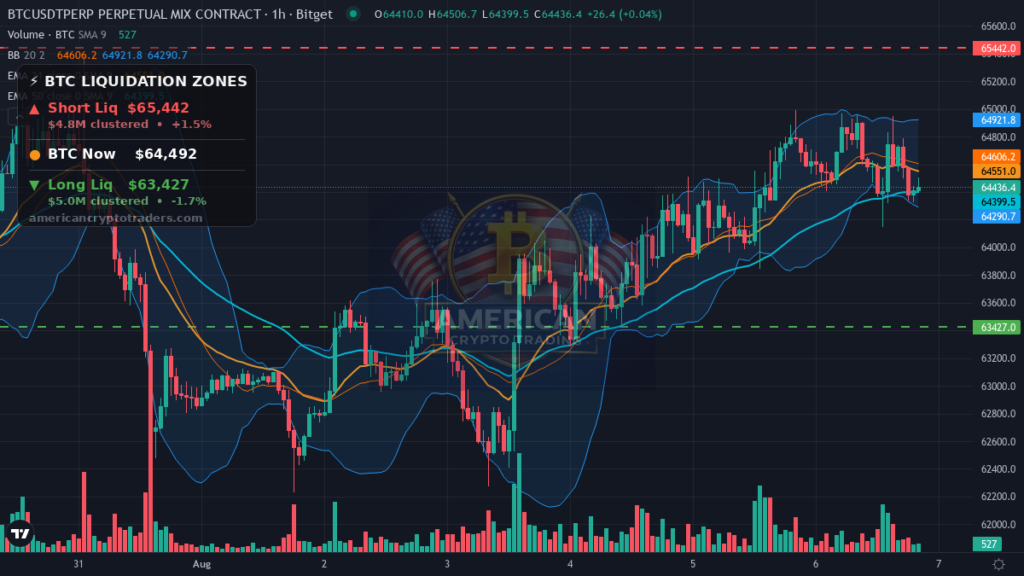
The liquidation map adds important context for the sessions ahead. On the short side, clustered liquidations sit at $65,442 — approximately 1.5% above current price, representing roughly $4.8 million in short positions that would be forced to cover on a push through that level. A break above $65,442 would cascade into short-covering and could accelerate a move toward $66K quickly. On the long side, the danger zone is $63,427 — about 1.7% below current price — where approximately $5.0 million in leveraged long positions would be liquidated on a flush. A break below that level would likely trigger a fast, sharp move down as stop-losses and forced liquidations compound each other. With price currently coiling between those two walls, the next directional break will be meaningful.
The Macro Picture
The macro backdrop heading into the Asia open is a continuation of today’s theme: stagflation anxiety sitting on top of an already-compressed market. DXY at 99.97 is approaching the psychologically significant 100 level, and if it breaks through that threshold overnight, additional headwinds for risk assets are possible. Gold’s continued bid above $4,300 is not a sign of confidence — it is a sign that large pools of capital are seeking inflation protection over growth exposure.
One news item worth flagging for context: Bitcoin ETF inflows reportedly surged in a period linked to the Coldplay hardware wallet hack, though analysts noted the connection was unclear. The fact that inflows continued through a security-headline environment is a mild positive for structural demand, but it is not enough to override the macro tone in the near term.
Levels to Watch
For the Asia and London sessions, the map is relatively clean. $65,442 is the line in the sand to the upside — reclaiming that level would trigger short liquidations and could shift intraday sentiment from defensive to cautiously constructive. Above there, the next meaningful resistance cluster is in the $66,000–$66,500 zone. $63,427 is the critical support to defend on the downside; losing it opens a path toward the $62,000 area, which would represent a more significant structural breakdown. The 24-hour low of $64,147 serves as the first near-term support before the liquidation threshold is tested.
Upcoming Catalysts
The single most important near-term catalyst is the US Senate vote on the CLARITY crypto bill, which Senator Tim Scott confirmed will happen this week “without any question.” This vote could move regulatory sentiment sharply in either direction — a passage would be a meaningful positive for institutional confidence in US crypto markets, while a delay or defeat could add to the current Extreme Fear environment. Given Congress operates on US time, any developments are most likely to land during US hours tomorrow, but headline risk is live for Asia and London sessions overnight.
Sentiment Check
The Fear & Greed Index closed the session at 25 — Extreme Fear. That is a level historically associated with capitulation-adjacent positioning, not euphoria, and it is consistent with the negative funding rates and cautious price action observed today. Extreme Fear does not guarantee an imminent bottom, but it does suggest that the easy money on the short side may already be positioned. For longer-term context on how monthly candle structure has historically behaved during periods like this, our 28-for-28 monthly candle analysis is worth reviewing. Sentiment at these levels has historically preceded some of the more significant relief rallies in Bitcoin’s history — though macro conditions today are more complex than in most prior Extreme Fear episodes.
Bottom Line
Today’s session was a textbook macro-driven compression trade. PMI data handed bears a narrative — stagflation — that is genuinely difficult for risk assets to fight, and Bitcoin obliged by sitting heavy under $65K for the entire New York afternoon. The liquidation map creates a binary setup for the hours ahead: a push above $65,442 forces shorts to cover and could spark a meaningful relief rally, while a break below $63,427 accelerates liquidation-driven downside. With the CLARITY Senate vote imminent and sentiment sitting at Extreme Fear 25, the next 24–48 hours carry more event risk than the quiet tape might suggest.
Disclaimer: This recap is for educational and informational purposes only and does not constitute financial advice. Cryptocurrency trading involves substantial risk of loss. Always do your own research. American Crypto Traders and its contributors may hold positions in the assets discussed.