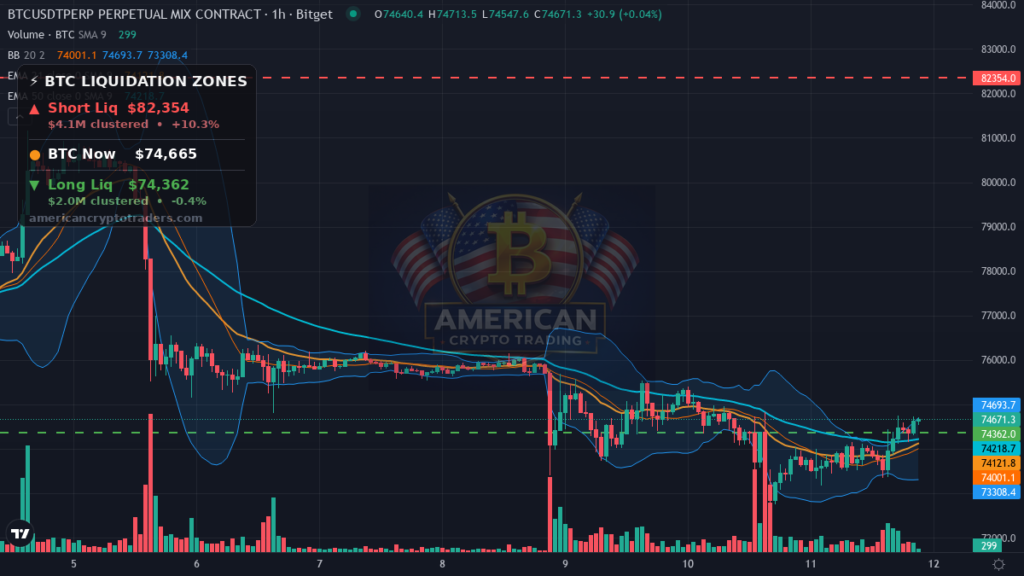
Wednesday’s New York session closed with Bitcoin at $74,671, up a modest 0.98% on the day but well short of what a 1.31% S&P 500 rally would typically pull out of crypto. This bitcoin market recap breaks down why the lag happened, what the liquidation map looks like heading into Asia, and which signals deserve attention before London opens tomorrow.
Bitcoin Market Recap: Equities Surged — BTC Barely Followed
Bitcoin traded between a session low of $73,178 and a high of $74,750 — a range of roughly $1,572 — before settling near the top of that band into the close. The price action looked like a reluctant bounce: enough strength to avoid a fresh breakdown, not enough conviction to push through resistance. Total crypto market cap sits at approximately $2.50 trillion, though the 24-hour market cap change printed at -1.7%, a reminder that today’s green candle is recovering ground lost earlier rather than marking a new leg higher.
What Moved Markets Today
The S&P 500 surged 1.31% and the dollar gained 0.69% simultaneously, creating a confusing signal for risk assets. Normally, a strong equity session and a weakening dollar travel together — investors sell safe havens and buy growth. Today’s combination of risk-on equities alongside a rising DXY at 102.94 is unusual and potentially contradictory. The practical effect for Bitcoin was a ceiling: dollar strength makes BTC cheaper in dollar terms to international buyers and tightens global liquidity at the margin, so even as equities lifted sentiment, the dollar headwind capped gains near $74,700.
Short-term holders moved $3.6 billion in BTC to exchanges at a loss, applying direct distribution pressure throughout the session. When coins accumulated at higher prices are sent to exchanges at a loss, it signals that a cohort of recent buyers has capitulated — or is preparing to. That supply overhang sat on the order books all day, absorbing buy-side interest and compressing the trading range. It is one of the clearest mechanical explanations for why a broad market green day produced less than 1% upside in BTC.
Deutsche Bank officially went live with crypto custody services for companies and institutions after a five-year buildup. This is an infrastructure milestone rather than an immediate price catalyst — large institutional flows don’t materialize the moment a custody desk opens its doors. What it does represent is a tier-one, globally systemically important bank treating digital asset custody as a core business line, which removes a compliance and counterparty barrier for funds that previously had no regulated venue through which to hold crypto. The constructive long-term read is real; the short-term price impact was minimal, as the market is still digesting more immediate supply and macro pressures.
Altcoin Action
BTC dominance held elevated at 59.9%, a level that continues to signal capital remaining concentrated in Bitcoin rather than rotating into smaller assets. When dominance is sticky at multi-year highs in a Fear environment, altcoin bounces tend to be shallow and short-lived — that dynamic played out again today.
PEPE led the meme coin bleed with a -10.5% loss, the worst performer among tracked assets. Meme coins are historically the first to get cut when sentiment deteriorates and the last to recover, making PEPE’s drawdown a reasonable barometer of retail risk appetite — and right now that appetite is thin. BTW fell 9.5%, adding to the lower-liquidity token pain.
ICP gained 7.7% and was the standout on the long side, joined by PEARL +8.3% and NIGHT +13.3%. These are idiosyncratic moves in lower-cap names; without clear catalysts in the data, treat them as noise until volume confirms. ETH managed a quiet +0.95% to $2,079, and SOL led the majors at +1.76% to $84.92, though neither printed the kind of volume that would signal a durable rotation out of BTC.
Positioning and the Liquidation Map
With BTC printing at $74,665 at the time of the liquidation snapshot, the map is lopsided in a meaningful way. Long liquidations cluster at $74,362 — just $302 below current price, representing approximately $2.03 million in exposed leverage. A wick below that level would flush those longs and could accelerate into the $73,000 zone if sellers step in behind it. This is the near-term downside trap to respect, particularly in thin Asia-session liquidity.
Short liquidations sit at $82,354, roughly 10.3% above current price, representing about $4.08 million in short exposure. A sustained move through that level would trigger a cascade of forced short covering that could be violent given the compressed recent range — but getting there requires breaking through significant overhead supply. The asymmetry in the map means shorts have more room before they’re squeezed, while longs are walking close to a tripwire.
The Macro Picture
Gold fell 0.97% to $3,991, which in isolation looks like a risk-on rotation — investors selling the safe haven to buy equities. Combined with the dollar’s strength, however, it may also reflect some unwinding of the gold premium that built up during recent stress periods. The 10-year Treasury yield ticked up to 5.0%, a psychologically significant level that historically creates friction for growth assets including crypto, as it raises the opportunity cost of holding non-yielding assets.
The simultaneous movement of equities higher and the dollar stronger warrants a close watch on whether Asia follows the equity signal or the dollar signal when their session opens. If Asia leans into the dollar strength narrative and risk sells off, BTC’s thin long-side buffer near $74,362 becomes the first line of defense.
Levels to Watch
On the downside, $74,362 is the immediate long liquidation cluster — a dip through it on low Asia volume would be the tell for whether sellers are truly in control. Below there, the session low of $73,178 from today becomes the next meaningful reference. A close below that level on elevated volume would be a material deterioration in the technical picture.
On the upside, today’s high of $74,750 is the first ceiling, followed by a clear air pocket up to the short liquidation level at $82,354. Any London-session push through $75,000 with volume would begin to shift the intraday structure from bearish consolidation toward a genuine relief rally attempt.
Upcoming Catalysts
The macro calendar does not surface any scheduled high-impact events for the immediate Asia and London sessions ahead; traders should monitor any surprise headlines around the 10-year yield and DXY direction as the primary exogenous inputs overnight.
Sentiment Check
The Fear & Greed Index reads 29 — Fear, consistent with the short-term holder capitulation data and the compressed price action. Fear readings at this level have historically marked zones where patient buyers find value, but they can also persist and deepen before reversing — bottoms are a process, not a single moment. For longer-term context on where November fits within Bitcoin’s cyclical patterns, see our 28-for-28 monthly candle analysis. BTC funding on perpetuals is effectively flat at -0.000001, confirming there’s no aggressive short bias being paid for — the market is genuinely uncertain rather than positioned heavily in either direction.
Bottom Line
Today’s session was a qualified relief bounce — the kind where the price technically went up but nothing felt particularly convincing. Short-term holders distributing $3.6 billion at a loss is not the behavior of a market ready to run; it’s the behavior of a market still working through overhead supply. The dollar-equity divergence adds a layer of macro complexity that makes the overnight session genuinely difficult to read with confidence.
The honest desk read: respect the $74,362 long liquidation level as a near-term trapdoor, don’t chase the green candle without a volume catalyst, and watch the DXY overnight for the cleaner directional signal. Deutsche Bank’s custody launch is the kind of news that matters in six months, not six hours.
Disclaimer: This recap is for educational and informational purposes only and does not constitute financial advice. Cryptocurrency trading involves substantial risk of loss. Always do your own research. American Crypto Traders and its contributors may hold positions in the assets discussed.