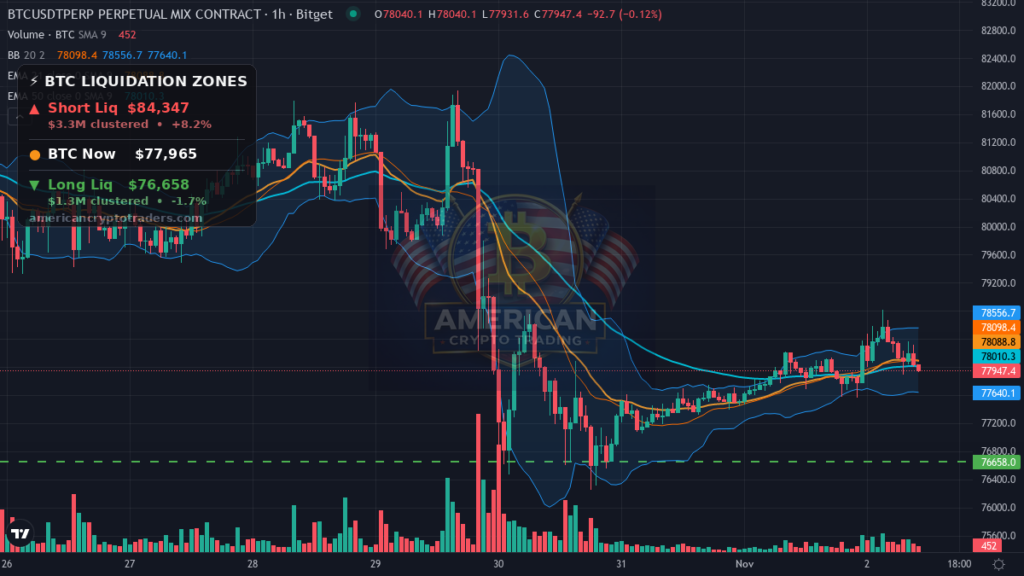
As we gear up for the New York session, Bitcoin currently sits at $77,948, down just -0.17% over the past 24 hours after overnight markets spent the Asia and London sessions absorbing the full weight of the Binance hack fallout, a $643 million ETF exodus, and growing unease ahead of today’s U.S. midterm elections.
Bitcoin Market Recap: Flat Holding Pattern Masks a Dangerous Undercurrent
On the surface, this bitcoin market recap looks almost uneventful — a -0.17% move is barely a rounding error in crypto terms. But the overnight range of $77,567 to $78,819 tells a more nuanced story: bulls defended the lower boundary more than once during Asian hours, keeping price above the week’s lows even as exchange contagion fears spread and ETF redemptions piled up.
The total crypto market cap shed -2.82% over the past 24 hours to sit at roughly $2.60 trillion, with BTC dominance pinned at exactly 60.0%. That dominance figure is meaningful — capital isn’t rotating into alts for risk-on speculation. It’s clustering in Bitcoin as the perceived safe harbor within a market that is anything but safe right now.
With S&P 500 futures already down -1.82% heading into the cash open at 9:30 AM ET, the cross-asset setup into the NY open is about as unfriendly as it gets. Crypto rarely ignores equity selloffs of this magnitude when sentiment is already fearful.
What Moved Markets Overnight
The Binance hack is now confirmed as the largest crypto exchange breach in history, with net outflows surging to $5.8 billion as withdrawals resumed. The mechanics here matter: when a major exchange suffers a breach of this scale, the rational response for any user with meaningful holdings is to move funds off-platform immediately. That reflexive withdrawal behavior is exactly what we saw — a self-reinforcing bank-run dynamic that has pushed outflows well past the initial shock estimates. The hack’s scale and the speed of the outflow response have shaken confidence in centralized exchange custody at a structural level, not just a short-term one.
Bitcoin ETF investors pulled $643 million out of spot ETF products in the wake of the hack, turning October into a net-outflow month for what had been one of 2026’s strongest institutional demand channels. The mechanism is straightforward: institutional allocators are risk-managed, and an unprecedented custodial failure at the world’s largest exchange is exactly the kind of tail-risk event that triggers forced de-risking regardless of where BTC actually trades. When the institutions that were supposed to provide steady buy-side flow flip to sellers, it removes a critical price support pillar and puts more weight on retail and futures-market participants to hold the line.
THORChain halted all swap activity after a block reorg bug was discovered on its network — but the halt had an unintended secondary effect of slowing the hackers’ ability to launder and move stolen funds across chains. The reorg bug exposed fragility in cross-chain infrastructure at precisely the wrong moment, raising broader questions about protocol-level contagion risk. If hackers cannot easily bridge or swap stolen assets, the immediate liquidation pressure on markets is reduced — but the underlying infrastructure concern remains elevated and is not resolved by a halt.
OKX absorbed $445 million in net inflows overnight as traders rotated exchange exposure away from Binance in a classic flight-to-safety trade within crypto. This is the exchange-level equivalent of moving deposits from a stressed regional bank to a larger institution — rational behavior under uncertainty. The inflow concentration at OKX signals that the market is not in full panic mode, since capital is staying within the crypto ecosystem rather than exiting to fiat entirely. But it does represent a meaningful reshuffling of exchange-level risk and liquidity that will take time to fully digest.
Altcoin Action
The altcoin complex is taking the brunt of the risk-off move, with the most vulnerable assets hit hardest. BTW is the session’s worst performer, cratering -16.2% — a reminder of how quickly thin-liquidity tokens can unwind when sentiment deteriorates and leveraged longs get unwound en masse.
NEAR is down -6.9%, reflecting both its higher beta to market risk and likely some protocol-specific concern given the broader cross-chain infrastructure anxiety sparked by the THORChain halt. SOL drops -1.51%, holding up better than the smaller caps but still lagging significantly behind Bitcoin’s near-flat performance.
On the gainers side, RAIN (+3.3%), PEARL (+2.9%), and JST (+2.5%) are showing green, but with the total market down -2.82%, these are isolated pockets rather than any kind of broad recovery signal. ETH is the quiet outperformer of the session at +0.69%, trading between $2,245.78 and $2,316.66, with a 24-hour volume of $958 million suggesting genuine buying interest rather than just reduced selling.
Positioning and the Liquidation Map
Funding rates remain positive across the board — BTC at 0.0083% and ETH at 0.0055% — which tells us the futures market is still skewed long even after the overnight stress. Positive funding in a Fear environment is a structural risk: if spot price breaks lower, overleveraged longs get forced out and funding flips negative rapidly, accelerating the move.
The liquidation map is asymmetric and worth understanding clearly. On the downside, a break below $76,658 would trigger approximately $1.28 million in long liquidations — that level sits just -1.7% below current price, meaning it’s uncomfortably close. A flush to that zone would likely accelerate as stops cluster below it, and the week’s lows around $77,567 become the first line of defense.
On the upside, a rally to $84,347 would squeeze approximately $3.34 million in short positions — that’s +8.2% above current price and represents a meaningful short squeeze target if NY buyers show up with conviction. Given current sentiment and the macro headwinds, that scenario is the less probable path into today’s session, but it’s the one that would change the narrative fastest.
The Macro Picture
The macro backdrop heading into the NY open is defined by two dominant forces: exchange contagion risk from the Binance hack, and U.S. midterm election uncertainty. S&P 500 futures are down -1.82% to 7,580 — equity markets are not going to provide any tailwind when the cash session begins at 9:30 AM ET. Cross-asset volatility is elevated, and crypto rarely decouples cleanly from that kind of equity pressure.
The DXY sits at 101.61 with no change overnight, and gold holds at $3,906.50 — neither the dollar nor gold is spiking, which suggests this is targeted risk-off rather than a full macro flight-to-safety. The 10-year Treasury yield eased -1.2% to 4.93%, a small but notable bond bid that reinforces the risk-off tone without signaling outright panic. Hong Kong’s move toward tokenized 24/7 settlement and stablecoin trials, reported overnight, is a constructive long-term headline but carries zero weight for today’s session dynamics.
Levels to Watch
To the downside, $77,567 is the overnight low and the first level bulls need to defend when NY desks arrive. Below that, $76,658 is the long liquidation cluster — a break there opens a faster move lower. Below $76,658, the $75,000 round number becomes the next psychological anchor.
To the upside, bulls need to reclaim $78,819 — the overnight high — to suggest any kind of stabilization. A push through $80,000 would materially shift the short-term narrative, and $84,347 is where the short squeeze begins in earnest if momentum builds into the NY open.
Upcoming Catalysts
The dominant catalyst today is the U.S. midterm elections — results will begin to emerge this evening, but headline risk from early polling data, exit polls, and pundit commentary will be elevated throughout the NY session and into the evening. Beyond the elections, the macro calendar is relatively quiet for scheduled data releases, meaning the Binance hack narrative and midterm sentiment will drive price action for the foreseeable session.
Sentiment Check
The Fear & Greed Index sits at 37 — Fear. That reading is consistent with what the price action and exchange flow data are telling us: this is a market looking for reasons to sell, not buy. Historically, Fear-zone readings in the 30s have preceded some of Bitcoin’s better medium-term entry points, but timing the exact bottom in the middle of an active exchange crisis is a different challenge than buying fear in a structurally healthy market.
For the longer-term context on where monthly candle structure sits heading into November, the 28-for-28 monthly candle analysis remains one of the most important frameworks on our site for understanding Bitcoin’s macro rhythm. Worth revisiting given the current setup.
Bottom Line
Bitcoin is holding its composure better than the surrounding narrative might suggest — a -0.17% print in the face of a record exchange hack, $643 million in ETF outflows, and negative equity futures is genuinely resilient price action. But resilient is not the same as safe. The $76,658 long liquidation level is close, midterm election headline risk is a wildcard all session, and altcoin weakness suggests the broader market is not ready to rally.
Watch how BTC responds when NY desks arrive. If buyers show up and defend $77,567 with conviction, a grind back toward $78,819 is achievable. If the equity open adds pressure and the Binance narrative worsens, $76,658 will be tested — and how price reacts there will tell you everything you need to know about whether this week’s lows hold.
Disclaimer: This recap is for educational and informational purposes only and does not constitute financial advice. Cryptocurrency trading involves substantial risk of loss. Always do your own research. American Crypto Traders and its contributors may hold positions in the assets discussed.