Bitcoin Market Recap: Yield Pressure Keeps Bitcoin Below $80K Heading Into the NY Open
As we gear up for the New York session, Bitcoin currently sits at $79,684, down 1.02% over the past 24 hours after selling off from an overnight high of $80,812 and testing lows near $79,424. The pullback unfolded against a backdrop of rising Treasury yields, a broad crypto market cap drawdown of 3.17%, and a fresh security scare in the hardware wallet space — a combination that kept bulls cautious heading into the U.S. cash open at 9:30 AM ET.
The mood is not panic, but it is not comfortable either. BTC dominance holds at 60.0%, suggesting the market is rotating defensively into Bitcoin rather than chasing altcoin risk. The question when NY desks arrive is whether that relative strength becomes a floor — or simply the last domino standing.
What Moved Markets Overnight
Bitcoin ETFs netted $110M in inflows after a brutal $774M exit in the prior session. On its face this looks like institutional re-entry, and it is — but context matters. A $110M day barely dents a $774M bleed, and the overnight price action confirmed that the incremental demand was insufficient to arrest selling pressure. The more important signal is directional: large money paused its exit. If that stabilization continues into today’s NY session, it forms a base; if ETF flows turn negative again, the $79,424 overnight low becomes the next line in the sand.
Ripple received final OCC approval for a national trust bank charter, delivering a meaningful regulatory clarity signal for the broader sector. This is not purely an XRP story. The OCC green-lighting a crypto-native firm as a federally chartered bank sets a structural precedent, implying that digital asset companies can operate within the U.S. banking framework rather than around it. Markets absorbed the news constructively at the margin — it did not arrest the overnight slide, but it reinforces the longer-term legitimacy narrative that underpins institutional allocation decisions.
The Keystone hardware wallet breach deepened, with hackers confirmed to have stolen the signing key used to verify wallets as genuine. This is more serious than a typical exchange hack. A compromised signing key means bad actors could theoretically distribute counterfeit Keystone devices that appear authentic — a supply-chain-level attack on self-custody infrastructure. The immediate market impact is sentiment-driven: any event that erodes confidence in cold storage solutions pushes retail toward custodial solutions and creates headline risk for hardware wallet holders broadly. Watch for further disclosures ahead of the NY open.
Altcoin Action
Solana was the session’s notable underperformer among majors, sliding 1.7% and briefly testing sub-$100 territory with a 24-hour low of $99.39. The $100 level carries significant psychological weight for SOL, and a confirmed close beneath it would invite further technical selling. Volume on SOL was relatively thin at $139M, suggesting the move was more about bid withdrawal than aggressive shorting — but thin bids break fast if sentiment deteriorates.
Ethereum mirrored Bitcoin almost tick-for-tick, declining 0.99% to $2,310. ETH traded a 24-hour range of $2,294 to $2,343, keeping it range-bound and largely directionless. Funding rates on ETH came in at a near-flat 0.009%, indicating neither side of the market is pressing hard — a coiled spring that could release in either direction into the NY open.
On the brighter side, MORPHO surged 7.0% to lead all gainers, followed by NIGHT at +4.5% and DASH at +4.0%. These moves stand in sharp contrast to the session’s top losers — RAIN at -11.6%, BTW at -8.5%, and SKY at -6.3%. The dispersion between winners and losers is wide, a hallmark of a risk-off environment where capital concentrates in specific narratives rather than lifting the whole market.
Positioning and the Liquidation Map
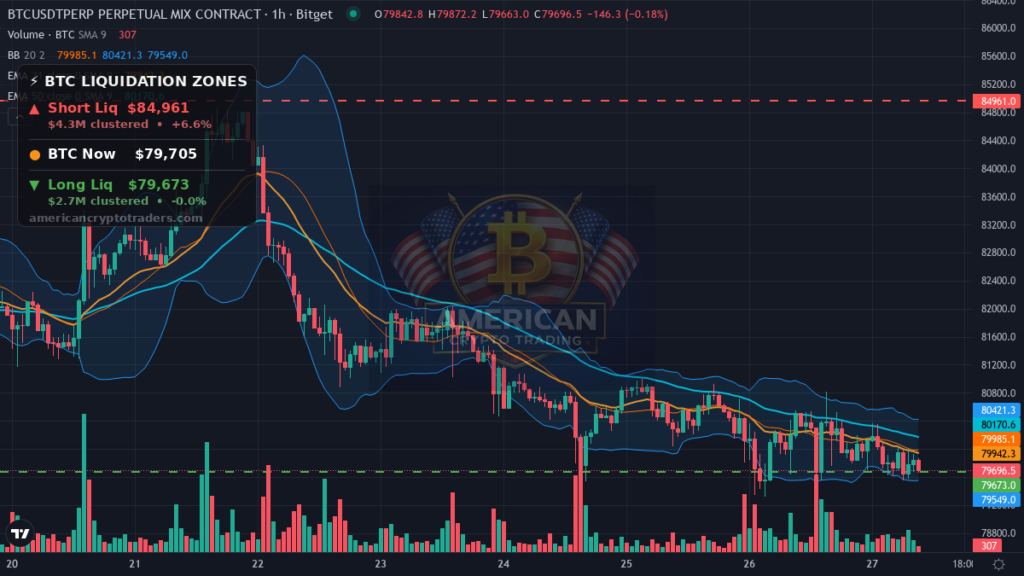
The liquidation map heading into the NY session tells a lopsided story. Long liquidations cluster at $79,673 — essentially at current price, given BTC is trading at $79,684. That proximity means a modest dip of roughly 0.01% triggers an estimated $2.67M in long liquidations, and a cascade from there could accelerate a move lower quickly. Bulls need to hold this level with conviction when NY desks come online.
On the upside, short liquidations are stacked at $84,961, approximately 6.6% above current price. A break of that level would force an estimated $4.25M in short covering and could generate a meaningful squeeze rally. However, reaching $84,961 requires sustained buying through several layers of overhead resistance — not a one-session story unless a significant catalyst materializes. For now, the path of least resistance favors the longs getting flushed before shorts get squeezed. BTC funding at a low 0.01% suggests the market is not aggressively positioned either way, keeping a squeeze scenario alive if buyers step in at the NY open.
The Macro Picture
The single most important macro variable this morning is the U.S. 10-year Treasury yield sitting at 4.99% — one basis point from the psychologically loaded 5.00% level. A cross above 5.00% on the 10-year has historically triggered risk-off rotation out of equities and speculative assets. Crypto, often the highest-beta risk asset in the room, would feel that move acutely if it materializes during today’s session.
The DXY crept up 0.28% to 102.25, adding mild headwind for dollar-denominated risk assets. Gold softened 0.72% to $4,009.20, perhaps signaling that even safe-haven demand is being crowded out by cash as yields rise. The S&P 500 futures are showing a prior close of 7,676.77, up 0.70%, but that number was set before overnight developments and may not reflect the full weight of today’s yield narrative when cash trading begins at 9:30 AM ET.
Levels to Watch
On the downside, $79,424 is the overnight low and the immediate support to defend into the NY open. A clean break there targets the long liquidation cluster at $79,673 — which is already essentially at current price — and then open air toward $78,000. On the upside, $80,812 is the overnight high; reclaiming it with volume would signal that dip buyers have taken control heading into the session. Beyond that, the $82,000–$83,000 zone represents the next meaningful resistance band before the short squeeze territory near $84,961.
Upcoming Catalysts
The macro calendar is relatively quiet for today’s session, though traders should monitor any intraday Treasury auction activity or Fed speaker commentary that could push the 10-year yield definitively above or below the 5.00% threshold — that single data point may do more to set today’s tone than any crypto-specific headline.
Sentiment Check
The Fear & Greed Index reads 48, labeled Neutral — a reading that sits directly on the fence between cautious optimism and outright fear. Neutral readings at support levels can be constructive; they suggest the market has not fully capitulated, meaning there is room for a relief rally if buyers show up at the NY open. At the same time, Neutral with yields threatening 5.00% and a hardware wallet breach in the headlines is a fragile equilibrium. For longer-term context on how monthly candle structure has historically resolved similar setups, see our 28-for-28 monthly candle analysis.
Bottom Line
Bitcoin heads into the NY open in a precarious but not broken position. The overnight session sold off from $80,812, stabilized just above $79,424, and now sits at $79,684 — within a few dollars of long liquidation triggers. The 10-year yield at 4.99% is the session’s wildcard: a cross above 5.00% risks triggering equity volatility that spills into crypto, while a retreat could relieve pressure and let the $110M ETF inflow narrative do its work. The Keystone breach adds a sentiment overhang that could weigh on retail confidence. Watch the 10-year, watch $79,424, and wait to see whether NY buyers show up with conviction or fold under the yield pressure.
Disclaimer: This recap is for educational and informational purposes only and does not constitute financial advice. Cryptocurrency trading involves substantial risk of loss. Always do your own research. American Crypto Traders and its contributors may hold positions in the assets discussed.