Bitcoin Market Recap: Binance’s Record Hack Batters Crypto on a Brutal October Friday
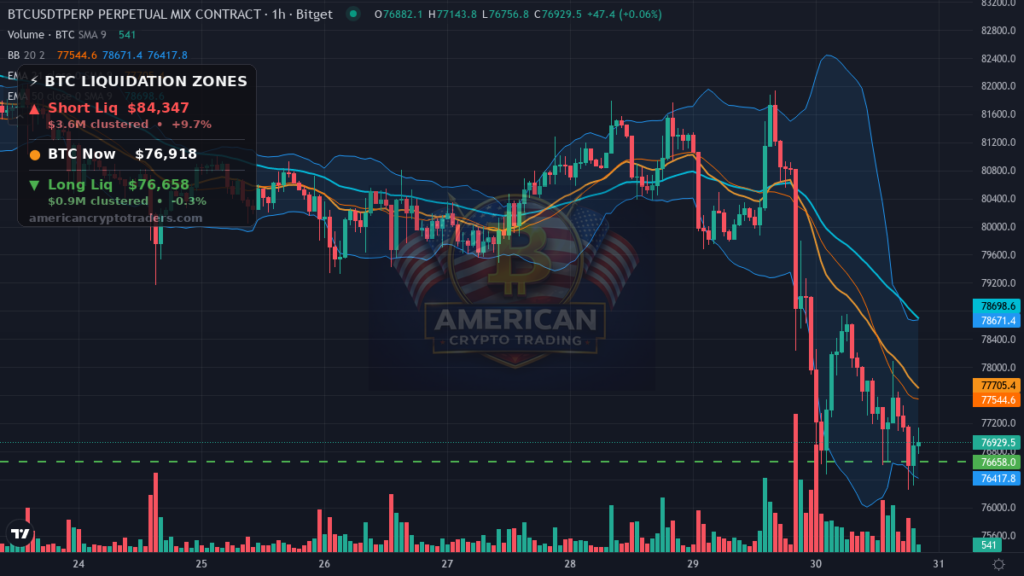
The bitcoin market recap for October 30, 2026 is a difficult one to write: a confirmed $6.3 billion hack at Binance — the largest exchange breach in crypto history — detonated across every asset class today, dragging BTC down 4.24% to close the New York session near $76,961, with an intraday low of $76,253. Volume on BTC spiked to roughly $5.86 billion in 24 hours, a clear signal of panic-driven liquidation rather than orderly selling. This was not a healthy flush; it was fear-driven capital flight, and the fallout is still developing as Asia prepares to open.
What Moved Markets Today
The Binance $6.3B hack confirmation was the single largest catalyst. News of the breach spread rapidly during the session, triggering an immediate and broad-based selloff as traders rushed to pull assets off exchanges. The psychological damage of a record exploit at the world’s largest centralized exchange cannot be overstated — it resurrects “not your keys, not your coins” sentiment at scale, and forced leveraged longs off their positions as confidence in custodial platforms evaporated. BTC fell from a session high of $80,450 to a low of $76,253, a move of more than $4,000 in a matter of hours. Binance communications regarding fund coverage remain the critical variable heading into Asia.
Traditional risk assets offered no shelter, compounding the crypto drawdown. The S&P 500 dropped 1.82% to 7,580, with tech leading the decline — a sector-specific selloff that reinforced the broader risk-off narrative. Gold, often cited as a safe-haven correlated to bitcoin’s long-term thesis, fell a jarring 3.51% to $3,889.90, stripping away any “digital gold” defense crypto bulls might have leaned on today. The simultaneous collapse in equities, gold, and crypto suggests macro funds and systematic strategies were reducing risk across the board, not rotating between assets. The 10-year Treasury yield fell 1.2% to 4.93%, consistent with a flight toward duration amid equity stress.
Tether’s Q3 reserve disclosure was the lone constructive data point of the session. Cointelegraph reported that Tether’s excess reserves nearly doubled to $8 billion, with Q3 profit hitting $1.5 billion — a meaningful signal that USDT’s backing remains robust even as the exchange ecosystem faces a crisis of confidence. In a session dominated by contagion fears, knowing that the largest stablecoin is better capitalized than ever provides a modest floor for sentiment. It does not stop the bleeding today, but it reduces the tail risk of a broader stablecoin collapse piling onto exchange fears.
Altcoin Action
Altcoins bore the brunt of today’s liquidation cascade, consistent with the pattern seen in every major exchange-shock event. The total crypto market cap shed 6.63% — more than 1.5 times BTC’s percentage loss — confirming that capital rotated defensively into bitcoin rather than fleeing crypto entirely. BTC dominance climbed to 59.1%, its highest reading in recent sessions, as traders treated BTC as the relative safe haven within a collapsing risk complex.
The hardest-hit names told the story clearly: BTW collapsed 16.0%, PEARL fell 13.9%, and ENA dropped 9.8%. These are the kinds of moves that characterize forced selling and thin liquidity, not fundamental reassessment. ETH held slightly better than the broader market, falling 3.27% to $2,240.64 with a low of $2,172.79, while SOL shed 4.43% to $94.99, dipping briefly under $92.25 before recovering. DOGE lost 3.93%, tracking closely with BTC’s beta.
A handful of names bucked the trend: NIGHT gained 3.5%, BCH added 2.8%, and SKY was up 2.0%. BCH’s relative strength is notable — in exchange-hack environments, some capital rotates toward assets perceived as simpler or less exchange-dependent, though the magnitude of these gains is modest against the backdrop of the broader carnage.
Positioning and the Liquidation Map
The liquidation map heading into the Asia open is lopsided in a way that matters. With BTC last printing near $76,917, the long liquidation cluster sits at $76,658 — just $259 below current price, representing approximately $902,000 in leveraged long exposure. A brief dip below that level would sweep those longs and could invite a cascade toward session lows near $76,253. Given the hack-driven sentiment environment, a stop-hunt into that zone during thin Asia hours is a real possibility.
On the upside, short liquidations are clustered at $84,347 — roughly 9.7% above current price, representing about $3.58 million in short exposure. A recovery to that level would require a dramatic reversal in narrative, likely dependent on Binance issuing credible fund-coverage communications and macro sentiment stabilizing. For now, the gravitational pull is firmly to the downside, and the asymmetry in liquidation dollar amounts suggests the market is more short-heavy than it appears — a potential fuel source for any relief rally if positive news emerges.
The Macro Picture
The DXY slipped 0.12% to 101.91, a mild dollar softening that would normally provide a modest tailwind for risk assets — today it was overwhelmed entirely by the exchange-specific shock. The 10-year yield at 4.93% remains elevated in absolute terms, keeping the cost-of-capital argument against speculative assets structurally in place. With equities, gold, and crypto all selling off simultaneously, this session had the character of a cross-asset deleveraging event rather than a crypto-specific rotation.
One headline worth noting: reports are circulating that bitcoin risks its worst October performance in 12 years as the tech selloff spreads. If BTC closes October below key psychological levels, it would represent a meaningful shift in the seasonal narrative that bulls have leaned on heading into Q4.
Levels to Watch
For the Asia and London sessions ahead, the immediate support to monitor is $76,658 — the long liquidation level. A clean break below that opens the door toward the session low of $76,253, and potentially psychological support at $75,000 if contagion fears accelerate. Traders should treat any wicks below $76,658 as high-noise, low-trust price action until volume confirms direction.
On the recovery side, BTC needs to reclaim $78,500 on meaningful volume to suggest the worst of the panic selling is over. The 24-hour high of $80,450 represents the pre-hack level and would be a significant reclaim signal. The short liquidation stack at $84,347 is the longer-term upside target if a genuine reversal takes hold, but that scenario requires a material positive catalyst — most likely from Binance itself.
Upcoming Catalysts
The macro calendar is quiet for the immediate Asia and London sessions ahead. The dominant catalyst driving price action into the weekend will be Binance’s official communications regarding hack scope, user fund coverage, and exchange solvency — watch official Binance channels closely at the Asia open. Any delay or ambiguity in those communications should be treated as a bearish signal.
Sentiment Check
The Fear & Greed Index closed at 30 — Fear. That reading is consistent with the session’s price action but is not yet at the extreme fear levels (sub-20) that have historically marked capitulation bottoms. Sentiment has room to deteriorate further if Asia opens with continued exchange contagion headlines. For longer-term context on how monthly candle structure interacts with sentiment extremes, see our 28-for-28 monthly candle analysis. Funding rates offer a nuanced picture: BTC funding is nearly flat at 0.0001, while ETH funding has flipped negative at -0.000157 — a sign that ETH traders are positioned short or hedged, which can support price if those shorts cover on stabilization.
Bottom Line
Today was a session defined by a single exogenous shock: a confirmed $6.3 billion Binance hack that triggered the largest exchange-related selloff in recent memory. BTC absorbed the blow better than most assets, closing at $76,961 with dominance climbing to 59.1% — a relative win in a session where almost everything bled. The structural concern is what happens next. If Binance communicates clearly and credibly about fund coverage before or at the Asia open, a stabilization bounce is plausible. If communications are delayed or insufficient, the long liquidation cluster at $76,658 becomes the immediate target, with $76,253 and potentially $75,000 as the next floors.
Tether’s $8 billion reserve cushion is a genuine positive that gets lost in the noise today but matters for tail-risk assessment. Stay close to verified Binance communications, keep position sizes honest given the uncertainty, and do not chase bounces until the exchange contagion narrative has a clearer resolution.
Disclaimer: This recap is for educational and informational purposes only and does not constitute financial advice. Cryptocurrency trading involves substantial risk of loss. Always do your own research. American Crypto Traders and its contributors may hold positions in the assets discussed.