Bitcoin Market Recap: Risk-Off Avalanche as Bonds Break the Market
Tuesday’s New York session delivered one of the sharper single-day selloffs of the quarter, with the bitcoin market recap painting an ugly picture across virtually every risk asset class. BTC shed 4.66% to close near $75,701, tagging a session low of $74,910 — the weakest print since late August — as a perfect storm of macro pressure, legislative failure, and fresh exchange fraud headlines converged on the tape.
The total crypto market cap declined 6.6% on the day to approximately $2.59 trillion, and BTC dominance actually ticked higher to 58.5% — a tell-tale sign that when selling is broad and indiscriminate, capital tends to seek relative shelter in Bitcoin even as Bitcoin itself falls.
What Moved Markets Today
The CLARITY Act failed its Senate cloture vote, removing a critical near-term bullish catalyst. The bill, which would have established a comprehensive regulatory framework for digital assets, could not muster the votes needed to advance to a full Senate debate. Markets had been quietly pricing in at least incremental progress on crypto legislation, and the failure flipped that positioning sharply. Without a defined regulatory pathway, institutional allocators have one less reason to add exposure here — and several more reasons to trim it. The selling that followed the vote announcement was pointed and mechanical, not panicked, suggesting it came from desks unwinding positions rather than retail stop-outs.
The U.S. 10-year Treasury yield breaking through and closing at 5.0% (+0.71%) was the macro sledgehammer behind the session. A yield at multi-decade highs fundamentally reprices the opportunity cost of holding non-yielding or speculative assets. Bitcoin, which has increasingly traded as a high-beta risk asset in rate-sensitive regimes, was hit accordingly. The S&P 500 dropped 0.45% to 7,585.73, and gold also softened 0.37% to $4,335.90 — confirming this was a broad risk-off move driven by the bond market rather than crypto-specific news alone. The DXY edged up 0.19% to 99.65, adding mild dollar headwind to crypto valuations.
Robinhood engineers were charged with fraud over alleged front-running of crypto listings, injecting fresh reputational risk into the session. The timing was particularly damaging — coming on a day when the market was already searching for excuses to sell. Allegations that insiders exploited advance knowledge of listing decisions to trade ahead of retail customers strike at the core of the trust-based narrative crypto has been building. While this is a Robinhood-specific legal matter, the spillover sentiment effect on crypto equities and exchange-adjacent tokens was immediate and negative.
Altcoin Action
Altcoins absorbed the worst of today’s damage, with the broad alt complex underperforming BTC by a meaningful margin. ETH fell 7.71% to $2,398.15, trading as low as $2,356.53 intraday, while SOL dropped 7.37% to $96.81 after briefly losing the $95.71 level. DOGE declined 6.86% to $0.0799.
XRP was among the ugliest prints of the session, down 14.6% — likely amplified by the CLARITY Act failure given XRP’s sensitivity to U.S. regulatory outcomes. FIL fell 15.1% and ICP shed 12.4%, rounding out the session’s worst performers. On the flip side, AKE surged 69.9% on what appears to be a token-specific catalyst, BTW gained 8.9%, and ARB added 3.5% — Standard Chartered’s note suggesting ARB could outperform BTC and ETH through 2030 may have provided a tailwind for the latter.
ETH funding rates flipped slightly negative at -0.000022, signaling that the short bias is beginning to build in perpetual markets. That is worth watching — it can either mean smart money is hedging downside, or it can set up a short squeeze if price stabilizes and begins to recover.
Positioning and the Liquidation Map
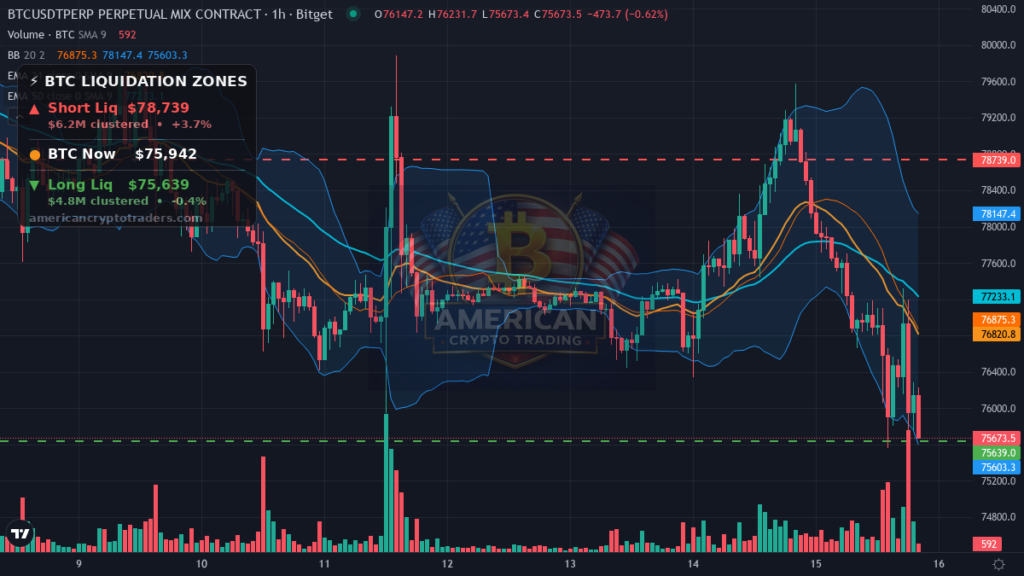
With BTC referenced near $75,942 at the time the liquidation data was pulled, the map is tight and the risk is two-directional. On the downside, the long liquidation cluster sits at $75,639, just $303 below that reference price — a move of roughly -0.4%. Approximately $4.77 million in long positions would be wiped at that level. Given how little cushion exists, any renewed selling pressure into the Asia open could cascade through that cluster and accelerate downside toward the session low of $74,910.
To the upside, short liquidations are stacked at $78,739, representing a 3.7% recovery from current levels with approximately $6.19 million in short exposure at risk. A reclaim of that level would force short-covering and could provide meaningful fuel for a relief rally — but it requires bulls to claw back nearly $3,000 first, which is a tall order given today’s macro backdrop.
BTC funding remains lightly positive at 0.000035, meaning longs are still paying shorts a small premium. That has not yet shifted to the bearish extreme seen in ETH, which suggests the full capitulation in positioning may not have arrived yet.
The Macro Picture
The 10-year yield at 5.0% is not just a number — it is a psychological and structural threshold that historically prompts portfolio rebalancing away from equities and risk assets. Fixed income at these levels becomes genuinely competitive with equity risk premiums for the first time in over a decade, and that competition is acutely felt by speculative assets like crypto.
A Bank of England official separately noted that stablecoin growth could actually reinforce dollar dominance and U.S. Treasury demand — an interesting structural counterpoint to the yield-driven selloff, but one that operates on a multi-year horizon rather than a session-by-session basis. For now, the bond market is in the driver’s seat, and crypto will continue to take directional cues from the 10-year until yields show signs of stabilizing.
Levels to Watch
For the Asia and London sessions ahead, the immediate line in the sand is $74,910 — today’s session low and the September floor. A confirmed break below that level opens the door to a more significant structural leg down, and given the long liquidation cluster at $75,639, the path there could be swift if selling resumes overnight.
To the upside, bulls need to recover and hold $77,000 as a first step toward stabilization. A push toward the short liquidation cluster at $78,739 would be the signal that dip-buyers have regained control and that a relief rally is credibly underway. Resistance from the 24-hour high of $79,451 would be the next meaningful level above that.
Upcoming Catalysts
The macro calendar is relatively quiet for the immediate Asia and London sessions ahead. Traders should monitor any developments on the CLARITY Act — whether the Senate revisits a revised bill or leadership comments on the timeline for crypto legislation — as that narrative will remain a headline risk. Continued movement in U.S. 10-year yields overnight will be the dominant macro signal to track.
Sentiment Check
The Fear & Greed Index closed the session at 69 — Greed, which is a striking disconnect from the price action and headline flow. A 4.66% single-day decline, multi-decade yield highs, a failed Senate bill, and fraud charges at a major broker typically shift sentiment readings — but the index reflects a broader rolling average and may lag the session’s damage. This divergence between a falling price and a still-greedy index is a cautionary signal: sentiment has not washed out, which means the capitulation trade may not have fully run its course yet. For additional context on longer-term cycle positioning, see our 28-for-28 monthly candle analysis.
Bottom Line
Today was a session where macro overwhelmed everything else. The CLARITY Act failure removed a bullish narrative, the 10-year at 5.0% removed risk appetite, and the Robinhood fraud charges removed trust — all on the same tape. BTC held above the psychologically important $74,910 low by the NY close, but the margin is thin and the liquidation map suggests the next few hours of Asia trading will be pivotal.
The setup heading into overnight trade is fragile. Longs at $75,639 are one bad candle away from being flushed, and until the bond market shows any sign of relief, crypto has limited ability to sustain a recovery. Watch the 10-year yield above all else. If it begins to roll over, crypto has a path to retest $78,000–$79,000. If it continues to climb, the September lows will be tested again — and likely broken.
Disclaimer: This recap is for educational and informational purposes only and does not constitute financial advice. Cryptocurrency trading involves substantial risk of loss. Always do your own research. American Crypto Traders and its contributors may hold positions in the assets discussed.